Herb–Drug Interactions
truth-hdi
Model card for truth-hdi, a life-sciences model that predicts when a medicinal plant will change how a prescribed drug behaves.
Research · Flagship
We are building an AI foundation model for life sciences that is evidence-led and traceable, starting with Ayurveda, medicinal plants and natural products, and expanding into modern biomedical research.
A domain-adapted model first, then a foundation model the foundation owns end to end.
Agents and workflows for discovery, safety, validation and standardisation, built on the model.
Knowledge about medicinal plants and natural products sits in classical texts, papers, formulation records, laboratory databases and the experience of practitioners. It is rarely connected, and when it is, the connections are hard to check.
General-purpose AI models answer questions in this field fluently. They do not reliably say where an answer came from, how strong the evidence is, or when sources disagree. They do not encode Indian knowledge systems or the questions Indian researchers and regulators are asking.
People combine herbal and Ayurvedic preparations with prescribed medicines, often without telling their doctor. Practitioners, pharmacists and regulators need to know which combinations are safe, which plants are what their label says, and which traditional claims hold up in the laboratory. Each of those is a question of evidence.
Evidence before fluency. Every answer the system gives should carry its citations, a confidence and any contradicting evidence. When the evidence does not support an answer, the system abstains.
A knowledge graph underneath the model. Plants, compounds, protein targets, diseases and the studies linking them are resolved to shared identifiers so evidence from different sources can be compared side by side.
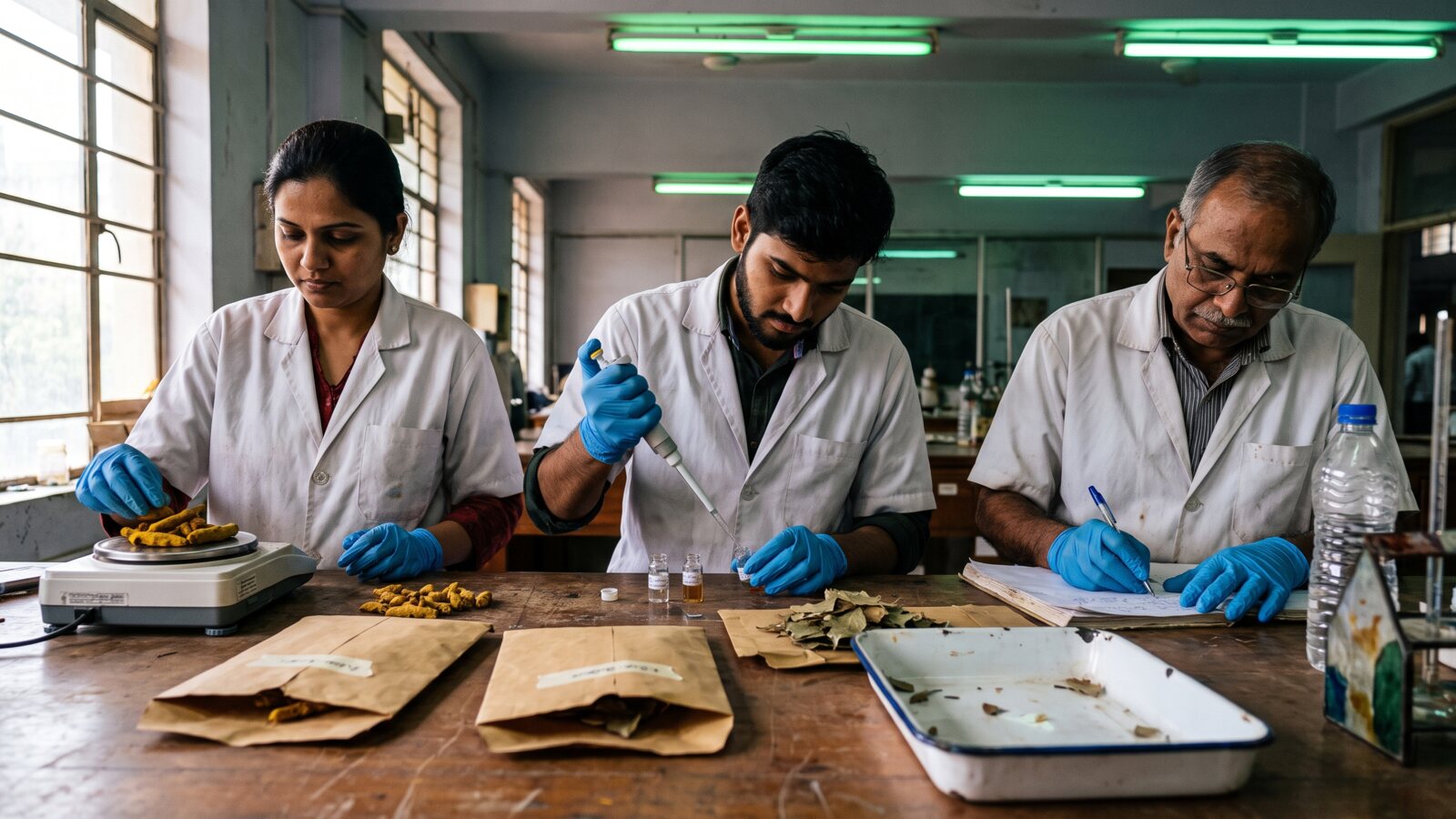
Experts and laboratories in the loop. The model proposes; practitioners review; wet labs test. Validated results become training and evaluation data, so the model improves on what has been checked, not on what has been repeated.
Open data, recorded licences. We use sources whose licences permit research use. Where a source forbids bulk download or training, we replace it with an open equivalent or drop it, and record the substitution.
The first concrete result is Herb–Drug Interactions (truth-hdi). Its data foundation is complete and a first, explainable model runs on it. There is no public release yet. See the model card for what has been measured.
The life-sciences model (truth-ls) is planned. Its first phase is continued pre-training of an existing open model on curated Ayurveda and life-sciences data.
The hard part is not the algorithm or the volume of data. It is labelled examples. Most published interaction records describe which drug was studied, not what happened to a specific herb–drug pair, so a model trained on them learns a drug's reputation rather than its pharmacology. We measured this and changed what the model claims to do. The full account is in Perspectives.
This is not an Ayurveda chatbot, and it is not a diagnostic tool. It is research infrastructure for people who study, regulate and practise in the life sciences.
Domain knowledge and scientific reasoning.
Plant, compound, target, disease and the evidence that links them.
Citations, confidence, contradictions and risk signals for every answer.
Formulation, discovery, safety and evidence review.
Phase 1
Continued pre-training of an existing foundation model on Ayurveda and life-sciences data.
Scale-up
Knowledge-graph grounding, partner datasets, expert evaluation and scientific benchmarks.
Phase 2
The foundation owns the model, weights, training stack, evaluation system and deployment environment.
Ayurveda, then biotechnology, then modern medicine.
The foundation leads the AI work, integrates the programme and stewards it long term. Partners ground the science.
Formulations, practitioner knowledge and industry context.
Research validation, annotation, publications and review.
Assays, analytical chemistry and experimental validation.
Strategic support, national alignment and mission funding.
| When | What |
|---|---|
| Q4 2026 | Data recipe, source licences and evaluation protocol for truth-hdi published |
| Q1 2027 | truth-hdi-0.1: mechanism model and enzyme potency model, with code |
| Q2 2027 | truth-hdi-0.2: ranking model trained on expert-reviewed labels |
| 2027 | truth-ls-0.1: domain-adapted life-sciences model, research preview |
truth-hdi
Model card for truth-hdi, a life-sciences model that predicts when a medicinal plant will change how a prescribed drug behaves.
truth-ls
Model card for truth-ls, a planned domain-adapted model for life-sciences research.